Dubai real estate investment in 2026 is shaped by rental yields between 6 and 8 percent, service charges that consume 15 to 25 percent of gross rent, and community-specific pricing that determines exit value more than emirate-wide averages. Investors who focus on net return mechanics and comparable sales data rather than headline gross yields make more accurate portfolio decisions.
What makes Dubai property attractive to investors
Dubai real estate investment continues to deliver measurable advantages in 2026 because the city combines zero taxation on rental income and capital gains with rental yields that sit between 6 and 8 percent in established communities. This structure allows investors to retain every dirham of gross rental income without the tax erosion that consumes 20 to 45 percent of returns in European and North American markets.
The emirate added over 100,000 new residents in 2025, creating structural rental demand that supports occupancy rates above 95 percent in mid-market areas like Jumeirah Village Circle, Business Bay, and Dubai South. This demographic expansion is driven by economic diversification, long-term residency visas, and the government's D33 agenda targeting 5 percent GDP growth in 2026.
Dubai's market transparency through the Dubai Land Department and the RERA Service Charge Index gives investors real-time access to transaction data, service charge benchmarks, and regulatory oversight that reduces pricing guesswork. House Finder helps buyers navigate this transparency by connecting them to verified listings and end-to-end transaction management across Dubai's active communities.
The capital also offers freehold ownership for international buyers in designated zones, Golden Visa eligibility for properties valued at AED 2 million or more, and transaction processes that complete within weeks rather than months. These advantages translate to faster capital deployment and clearer exit strategies compared to markets with restrictive foreign ownership rules.
Statistics from Q1 2026 show Dubai recorded AED 176.7 billion in property sales across nearly 48,000 transactions, reflecting a 23.4 percent year-on-year increase in value and 5.5 percent rise in volume, according to fäm Properties. This momentum confirms sustained investor confidence and liquidity.
Yield and growth fundamentals
Gross rental yields in Dubai averaged 6.5 to 7 percent in early 2026, with specific communities like International City and Discovery Gardens reporting yields between 7 and 9 percent. These figures outperform London, New York, and Singapore, where rental yields typically range from 2 to 4 percent due to higher property prices and taxation burdens.
Capital appreciation in Dubai moderated from the double-digit growth seen between 2023 and 2025, with analysts projecting 3 to 5 percent annual appreciation in well-maintained properties through 2026. This shift reflects a maturing market entering a more stable expansion phase rather than speculative momentum.
Population growth and infrastructure projects like the Dubai Metro expansion, Expo City development, and Al Maktoum International Airport upgrades create medium-term demand drivers that support both rental absorption and value stability. These catalysts are measurable and backed by government budgets rather than market speculation.
Tax environment and cost efficiency
Dubai levies a one-time 4 percent transfer fee at purchase through the Dubai Land Department, with no annual property tax, capital gains tax, or inheritance tax. This upfront cost structure means investors can model total ownership expenses with precision from day one.
The absence of ongoing taxation allows rental income to compound without erosion, creating a meaningful advantage for long-term holders. A property generating AED 78,000 in annual rent delivers that full amount to the owner after deducting service charges and maintenance, unlike comparable markets where tax consumes a third or more of gross returns.
This efficiency makes Dubai particularly attractive for high-net-worth investors seeking diversification away from tax-heavy jurisdictions, as well as portfolio builders focused on maximizing net cash flow rather than chasing headline appreciation.
The numbers that matter before you buy
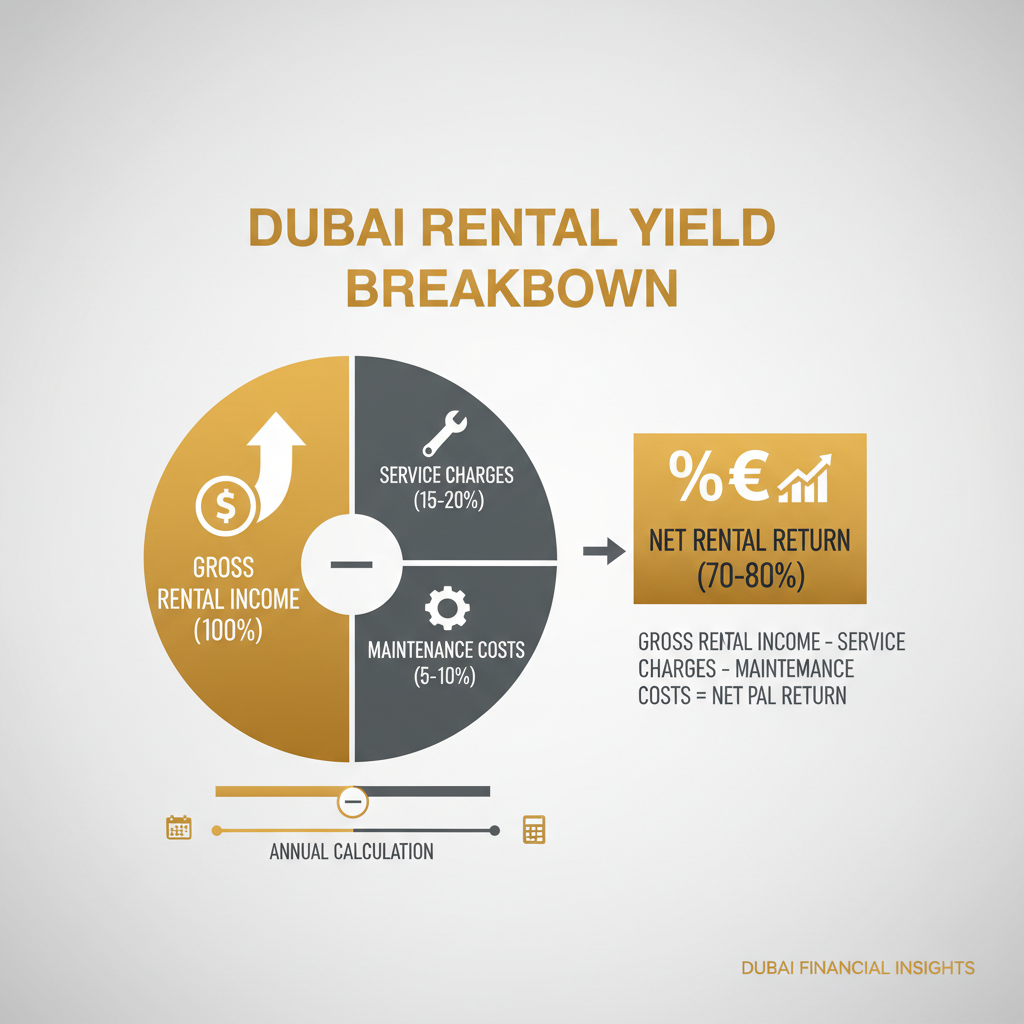
Rental yield measures annual rental income as a percentage of purchase price, but the gap between gross and net yield determines actual return. In Dubai, gross rental yield averages 6.5 to 7 percent citywide, while net rental yield after service charges, maintenance, and vacancy periods typically lands between 4.6 and 5.7 percent.
Service charges represent the single largest recurring expense for Dubai property owners, calculated per square foot annually and covering building maintenance, security, landscaping, pool and gym upkeep, and management fees. Average service charges range from AED 8 to 30 per square foot depending on community and developer, with premium towers sometimes exceeding AED 60 per square foot.
For a 1,000 square foot apartment in Business Bay with a service charge of AED 15 per square foot, the annual cost totals AED 15,000. If that unit generates AED 78,000 in annual rent, the service charge consumes 19.2 percent of gross income before any other expenses, reducing net rental income to AED 63,000.
The RERA Service Charge Index published by the Dubai Land Department allows investors to verify charges for any building before purchase, preventing surprises and enabling accurate net yield calculations. This transparency is a critical tool for due diligence.
Calculating net return accurately
Net rental yield requires subtracting all operating expenses from gross rental income, then dividing by total purchase cost including fees. The formula investors should use is: (Annual Rent – Service Charges – Maintenance – 5% Vacancy Allowance) / (Purchase Price + 4% DLD Fee + Agency Commission + Trustee Fees).
Using a worked example: a property purchased for AED 1,100,000 with annual rent of AED 78,000, service charges of AED 15,000, maintenance of AED 3,000, and a 5 percent vacancy allowance of AED 3,900 delivers net annual income of AED 56,100. Total acquisition cost including 4 percent DLD fee and 2 percent agency commission is approximately AED 1,166,000, producing a net yield of 4.8 percent.
This calculation reveals the real cash-on-cash return and allows comparison across properties and markets. Investors who skip this step often discover their actual returns are 30 to 40 percent lower than the gross yields marketed by developers and agents.
Service charges vary dramatically by developer and community. Emaar properties in Downtown Dubai can charge AED 20 to 30 per square foot, while Nakheel developments in Dubai South may charge AED 8 to 12 per square foot. These differences directly impact net yield and long-term profitability.
Financing impact on return
Mortgage financing in Dubai allows investors to amplify cash-on-cash returns by reducing upfront capital deployment. Using the same AED 1,100,000 property with 20 percent down payment (AED 220,000) plus closing costs (approximately AED 66,000 cash outlay for fees), total investor capital is AED 286,000.
If net annual income after all costs and mortgage payments totals AED 18,000, the cash-on-cash return on actual invested capital becomes 6.3 percent rather than 4.8 percent on the full purchase price. This leverage effect explains why financed buyers often achieve higher percentage returns despite mortgage interest costs.
However, mortgage costs in Dubai include arrangement fees of 1 percent, valuation fees of AED 2,500 to 3,500, and interest rates ranging from 4.5 to 6 percent depending on buyer profile and down payment. These expenses must be factored into the total return calculation.
Investors must also hold sufficient cash for closing costs, as Dubai banks require all fees to be paid separately from the mortgage amount as of 2026 regulatory changes. This means a 20 percent down payment purchase actually requires 27 to 30 percent liquid capital for execution.
Hidden costs that erode yield
District cooling fees in older buildings like some towers in Dubai Marina and JLT can add AED 5,000 or more annually to landlord expenses. These charges are often paid by the owner rather than the tenant and do not appear in standard service charge disclosures.
Vacancy periods average 30 to 45 days annually in high-turnover communities, particularly those popular with short-term contracts and rotating expat populations. A conservative 5 percent vacancy allowance is standard practice for net yield modeling.
Maintenance reserves should account for 1 to 2 percent of property value annually to cover appliance replacement, painting, and tenant turnover refresh costs. Properties rented furnished incur higher maintenance expenses than unfurnished units.
Ejari registration fees, DEWA connection deposits, and building insurance add smaller but cumulative costs that reduce first-year returns. Experienced investors budget an additional AED 5,000 to 8,000 for these items during initial setup.
How valuation shapes your exit price
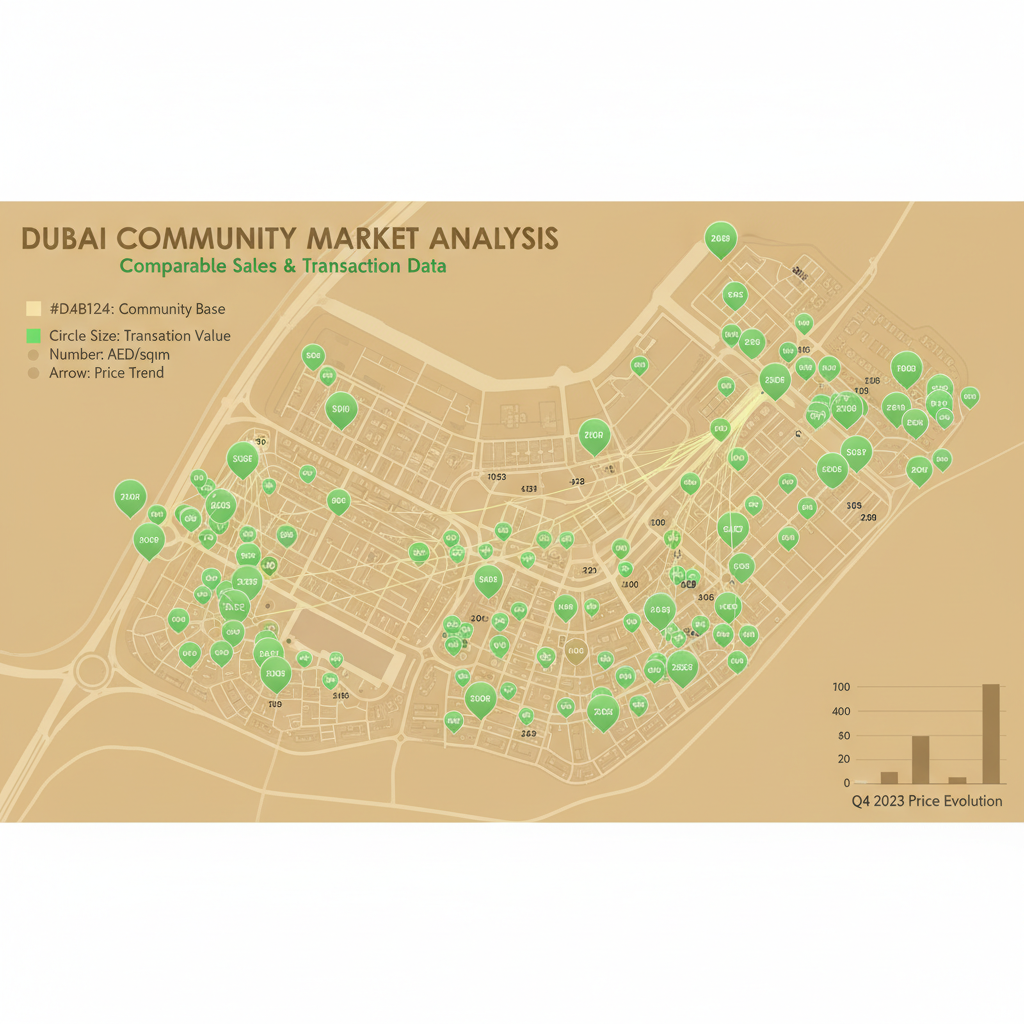
Property valuation in Dubai relies primarily on the sales comparison approach, where certified valuers identify recent comparable transactions and adjust for differences in size, floor level, view, condition, and building quality. This methodology means your exit price is determined by what similar units in your specific community have sold for in the preceding 90 to 180 days.
Community-level pricing matters more than citywide averages because buyers make purchase decisions based on neighborhood comparables rather than Dubai-wide median values. A property in Business Bay is benchmarked against other Business Bay sales, not against Downtown Dubai or Palm Jumeirah, even though all are premium locations.
The Dubai Land Department publishes transaction data through DXBInteract, giving investors and valuers access to real sales prices rather than asking prices. This transparency reduces valuation disputes and creates pricing discipline in resale negotiations.
RICS-qualified and RERA-certified valuers conduct site inspections, analyze transaction data, and prepare formal valuation reports accepted by banks, courts, and government authorities. These reports document comparable sales, adjustment rationale, and market conditions, providing defensible pricing evidence for mortgage financing and Golden Visa applications.
Comparable sales methodology
Valuers select three to five comparable properties sold within the past six months in the same building or community, ideally within 10 percent of the subject property's size. Adjustments are applied for floor level (higher floors command premiums), view quality, unit condition, and furnishing status.
A property on the 20th floor with Burj Khalifa views may command a 10 to 15 percent premium over an identical unit on the 5th floor with courtyard views. Similarly, recently renovated units with upgraded fixtures can achieve 5 to 8 percent premiums over dated comparable units.
These adjustments are documented in the valuation report with clear rationale tied to market evidence. Investors who understand this process can make targeted upgrades before sale to capture measurable value premiums rather than spending on cosmetic improvements with limited return.
Communities with high transaction volumes like JVC, Business Bay, and Dubai Marina have deep comparable sales databases, creating tight pricing bands and faster sales cycles. Emerging communities with limited resale activity face wider valuation ranges and longer marketing periods.
Developer and building quality impact
Properties developed by Emaar, Meraas, and Nakheel typically command 8 to 12 percent premiums over comparable units from smaller developers due to brand recognition, build quality, and perceived resale liquidity. These premiums persist across market cycles and are reflected in valuations.
Building-specific factors like management quality, service charge efficiency, and amenity condition directly affect market value. Buildings with well-maintained lobbies, functioning gym equipment, and responsive management teams attract better tenants and achieve faster sales at higher prices.
Proximity to metro stations, schools, and commercial centers creates location premiums that compound over time. Properties within 700 meters of metro stations historically appreciate 20 to 30 percent faster than those requiring car access, according to infrastructure impact studies.
Investors should verify whether a community has an active owners' association and transparent financial reporting through the Mollak system. Buildings with irregular service charge increases or deferred maintenance show pricing discounts of 5 to 10 percent compared to well-managed alternatives.
When Dubai beats broader UAE options
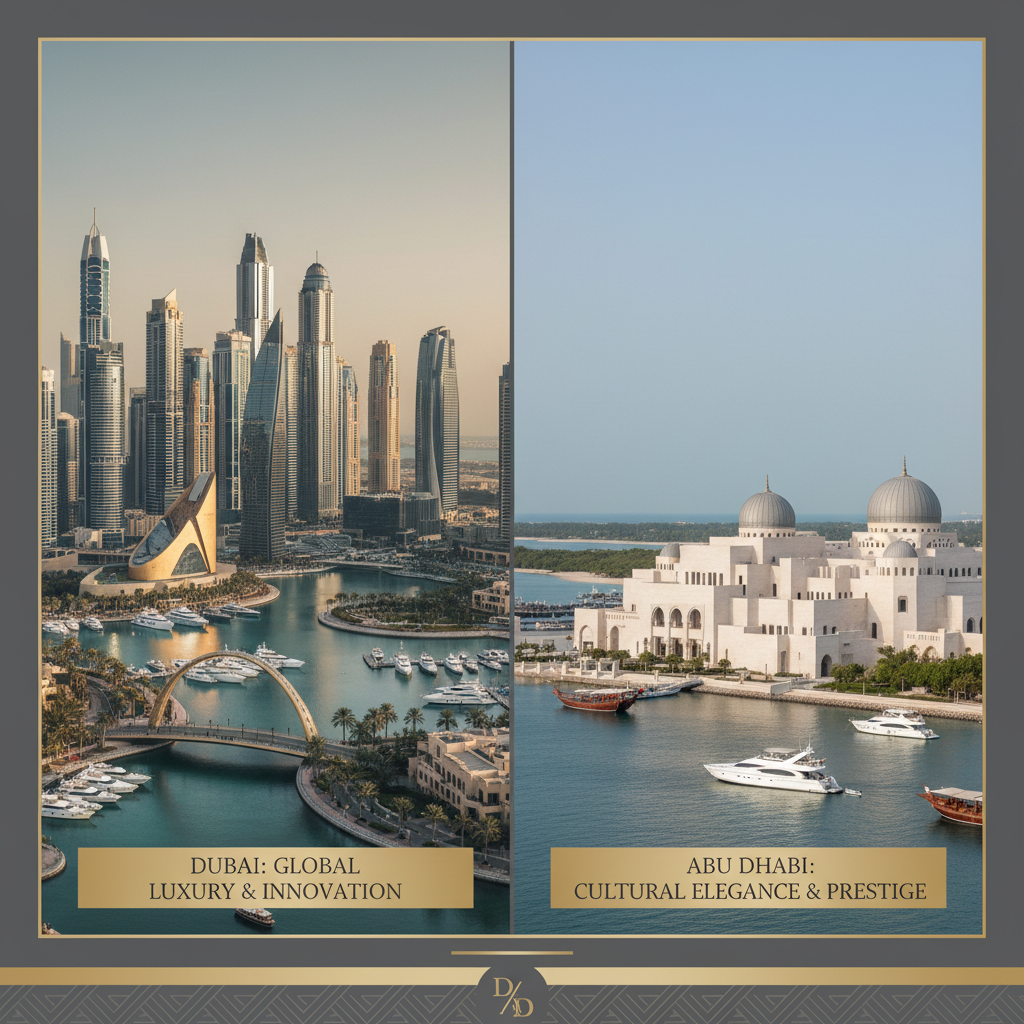
Dubai delivers higher rental yields than Abu Dhabi across comparable property types, with Dubai averaging 6 to 9 percent gross yields compared to Abu Dhabi's 5 to 7 percent range. This yield advantage reflects Dubai's faster tenant turnover, stronger short-term rental market, and deeper pool of international tenants.
However, Abu Dhabi offers steadier capital appreciation and lower volatility because of tighter supply controls, government-backed master developments, and a more conservative development pipeline. Abu Dhabi's property price growth has been more consistent year-over-year, while Dubai experiences sharper cycles.
Transaction costs favor Abu Dhabi, with a 2 percent DLD transfer fee compared to Dubai's 4 percent, reducing upfront acquisition expenses by AED 20,000 on a AED 1 million purchase. This difference matters for investors planning multiple transactions or higher-value acquisitions.
Dubai provides superior liquidity and faster exit options because of its larger transaction volume and deeper buyer pool. Properties in Dubai Marina or Business Bay typically sell within 30 to 60 days at market price, while comparable Abu Dhabi properties may require 60 to 90 days.
Market positioning and investor profile
Dubai suits investors prioritizing immediate rental income, short-term capital deployment, and frequent portfolio rotation. The market's velocity and transaction volume support active trading strategies and quicker capital recycling.
Abu Dhabi attracts long-term holders seeking stable appreciation, lower entry costs, and exposure to sovereign-backed infrastructure projects. The Golden Visa qualification threshold of AED 2 million applies equally in both emirates, but Abu Dhabi's lower property prices make the threshold more accessible.
Sharjah and Ras Al Khaimah offer the highest gross yields in the UAE, sometimes exceeding 9 percent, but face longer sales cycles, narrower buyer pools, and lower capital appreciation potential. These markets work for cash flow investors willing to sacrifice liquidity for yield.
Ajman and Fujairah remain niche markets with limited freehold zones and lower international buyer interest, making them suitable primarily for local investors or those with specific business or residential requirements in those emirates.
Infrastructure and economic drivers
Dubai's economy is led by trade, tourism, financial services, and entrepreneurship, creating diverse tenant demand across residential segments. Over 200,000 residential transactions worth AED 500 billion were recorded in 2025, reflecting exceptional market liquidity.
Abu Dhabi's economy centers on government, energy, sovereign wealth management, and industrial development, producing a stable high-income workforce that supports premium rental demand in communities like Saadiyat Island, Yas Island, and Al Reem Island.
The UAE economy is projected to grow 5 percent in 2026, with both emirates contributing significantly but through different sectoral drivers. This diversification allows portfolio investors to spread risk across economic models while staying within the same federal regulatory framework.
Dubai benefits from Expo City, the expanded Al Maktoum International Airport, and the Dubai Metro expansion, creating infrastructure-led demand in Dubai South, Jebel Ali, and emerging southern corridors. Abu Dhabi's catalysts include Warner Bros. World, Louvre Abu Dhabi, and the forthcoming Yas Island expansions targeting destination tourism.
Practical decision framework
Investors seeking yields above 7 percent and willing to accept market volatility should focus on Dubai's mid-market communities like JVC, Arjan, and International City, where gross yields reach 7 to 9 percent and net yields land between 5 and 6.5 percent.
Those prioritizing capital preservation and steady 3 to 5 percent annual appreciation with lower transaction costs should consider Abu Dhabi's master-planned communities like Al Reef, Masdar City, and selective Yas Island developments where yields are slightly lower but price stability is higher.
Portfolio diversification across both emirates allows investors to capture Dubai's rental velocity while benefiting from Abu Dhabi's appreciation stability, creating balanced total return profiles that outperform single-location concentration.
House Finder provides access to both Dubai and Abu Dhabi property markets through a single platform, offering verified listings, mortgage assistance, and transaction management that simplifies multi-emirate portfolio building. Their team helps investors compare net yields, model financing scenarios, and execute purchases with regulatory compliance across the UAE's most active markets.