Dubai Real Estate Trends That Matter Before You Buy in 2026
Dubai's property market is shifting into a more mature phase in 2026, where price stability, supply normalization, and end-user demand define the landscape rather than speculative rushes. Transaction activity remains robust, the city's population continues to expand beyond 4 million, and rental yields stay competitive globally—yet the signals buyers need to watch differ sharply from earlier boom cycles.
The trend signals worth watching
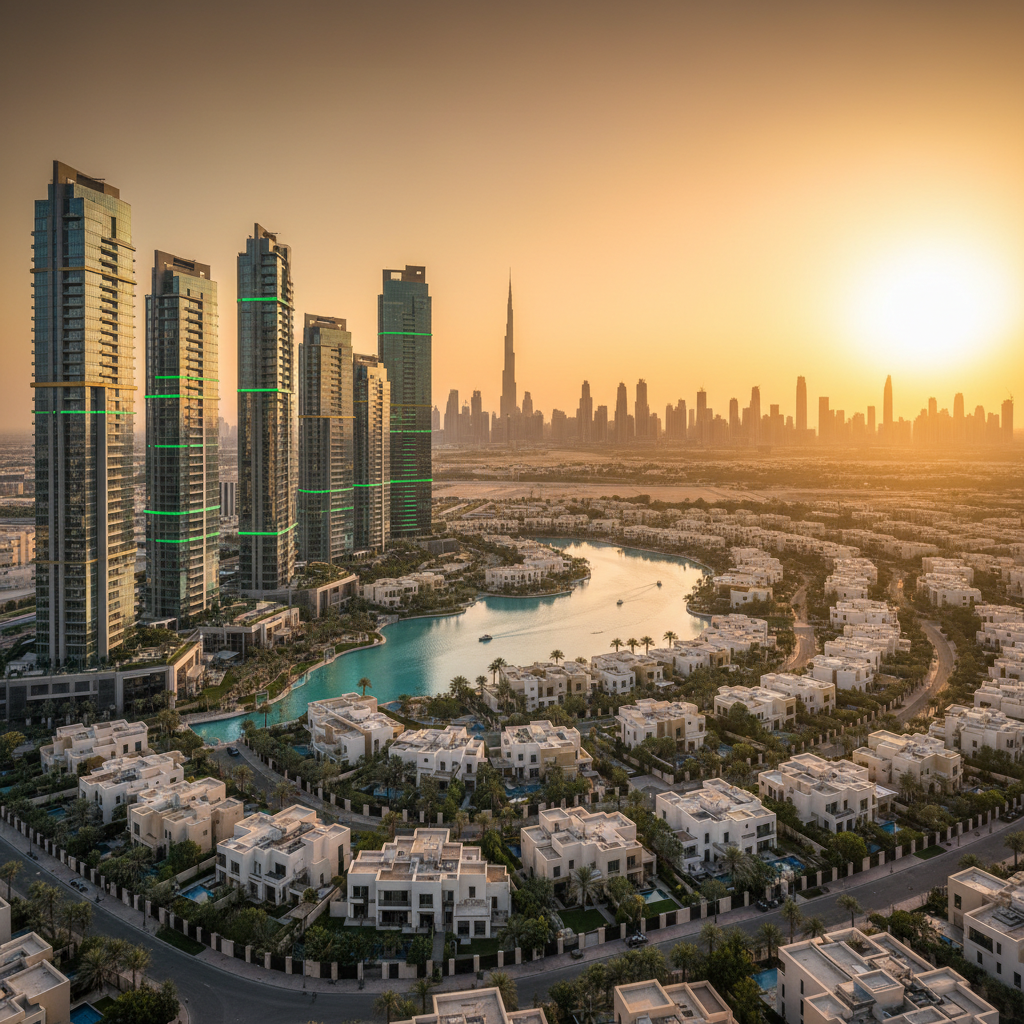 Understanding which trend signals actually matter before committing to a purchase means cutting through hype and focusing on demand drivers, price trajectories, and how fresh inventory shapes your negotiating position.
Demand remains robust but composition has changed
Dubai real estate continues to attract strong buyer interest, with Q1 2026 transaction value reaching AED 252 billion, a 31% year-on-year jump according to recent Dubai Land Department data. Yet the composition of buyers has evolved significantly.
End-users now represent over 85% of transactions, signaling that people are buying homes to live in rather than flip. The Golden Visa program added over 250,000 long-term residents since 2021, creating sustained housing demand that goes beyond investment cycles. Population growth added more than 200,000 residents in 2025 alone, and projections suggest another 175,000 to 225,000 people will settle in Dubai during 2026.
International capital remains a pillar of the market—foreign investment values climbed 26% to AED 148.35 billion in Q1 2026—but the nature of these purchases has matured. Buyers prioritize quality infrastructure, school proximity, and lifestyle amenities over early-stage projects in untested communities.
House Finder tracks these buyer behavior shifts closely, helping clients identify properties that align with both current demand patterns and long-term neighborhood stability.
Pricing trajectories show moderation not reversal
Price growth in Dubai real estate has slowed from the double-digit surges of 2023-2024, yet values remain elevated and directionally positive. Average residential prices rose 12.5% year-on-year to AED 1,759 per square foot in Q1 2026, according to market indices.
Villa prices have led appreciation since the pandemic, with freehold villa values climbing 206% from pre-pandemic levels. Apartments have also strengthened, surpassing prior-cycle highs for the first time. However, performance now varies significantly by community and property type rather than moving in broad lockstep.
Mid-market apartments in high-supply zones are showing the earliest signs of price moderation. Communities expecting multiple handovers between 2026 and 2027 may offer more room for negotiation. In contrast, villa communities with limited land supply and strong end-user demand—such as Dubai Hills Estate, Arabian Ranches, and Jumeirah Park—continue to hold pricing power.
Experts at House Finder analyze pricing trends at the community and building level, ensuring buyers understand where they can negotiate and where market fundamentals remain tight.
Prime and ultra-prime segments, particularly waterfront and golf-course properties, demonstrate resilience. Limited supply in these categories supports stable or modest appreciation even as mid-market inventory expands.
Supply dynamics require granular neighborhood analysis
Headline supply numbers often dominate discussions, yet delivery timelines, absorption rates, and geographic concentration matter far more than aggregate unit counts. Approximately 100,000 to 150,000 residential units are forecast to complete in 2026, raising questions about oversupply.
Yet historical data shows that 30% to 40% of predicted supply typically delays or phases beyond initial schedules. In 2025, around 42,000 units were delivered against higher forecasts. Meanwhile, population growth implies demand for roughly 50,000 additional homes annually, before accounting for replacement demand or second-home purchases.
Supply is not evenly distributed. Jumeirah Village Circle, Business Bay, Mohammed Bin Rashid City, Dubai Hills Estate, and Tilal Al Ghaf accounted for over 41% of units delivered in the first three quarters of 2025. Communities with heavy handover schedules may experience softening rental or resale activity, while neighborhoods with minimal new supply maintain tighter market conditions.
Villa and townhouse supply remains constrained compared to apartments. Most upcoming inventory consists of mid-market apartments, creating divergent conditions across asset classes. Buyers targeting family-oriented villa communities face a fundamentally different supply environment than those considering high-rise apartment clusters.
House Finder provides granular supply analysis for each target community, helping buyers understand whether they are entering a balanced, tight, or loosening micro-market.
Rental market dynamics continue to support yields
Rental yields in Dubai remain among the highest globally, with apartments averaging 7% gross yields and villas around 5% by late 2025. Net yields after service charges, maintenance, and vacancy typically settle between 4.7% and 6.7% for apartments, outperforming markets like London, New York, and Hong Kong.
Rental demand stays strong, supported by high occupancy rates and steady rent increases in suburban areas where supply has not yet caught up. Over 530,000 rental contracts were registered in 2025, a record that reflects sustained housing demand rather than transient movement.
Rent growth is moderating from the double-digit increases of recent years, with 2026 forecasts pointing to 6% to 8% growth in key communities. This deceleration is healthy, allowing income growth and financing conditions to realign without triggering sharp corrections.
Certain neighborhoods continue to deliver rental yields above 8%, particularly affordable communities like Jumeirah Village Circle, Discovery Gardens, and International City. Investors focused on cash flow prioritize these areas, while those seeking capital appreciation target supply-constrained villa communities or prime waterfront locations.
What trends mean for investors
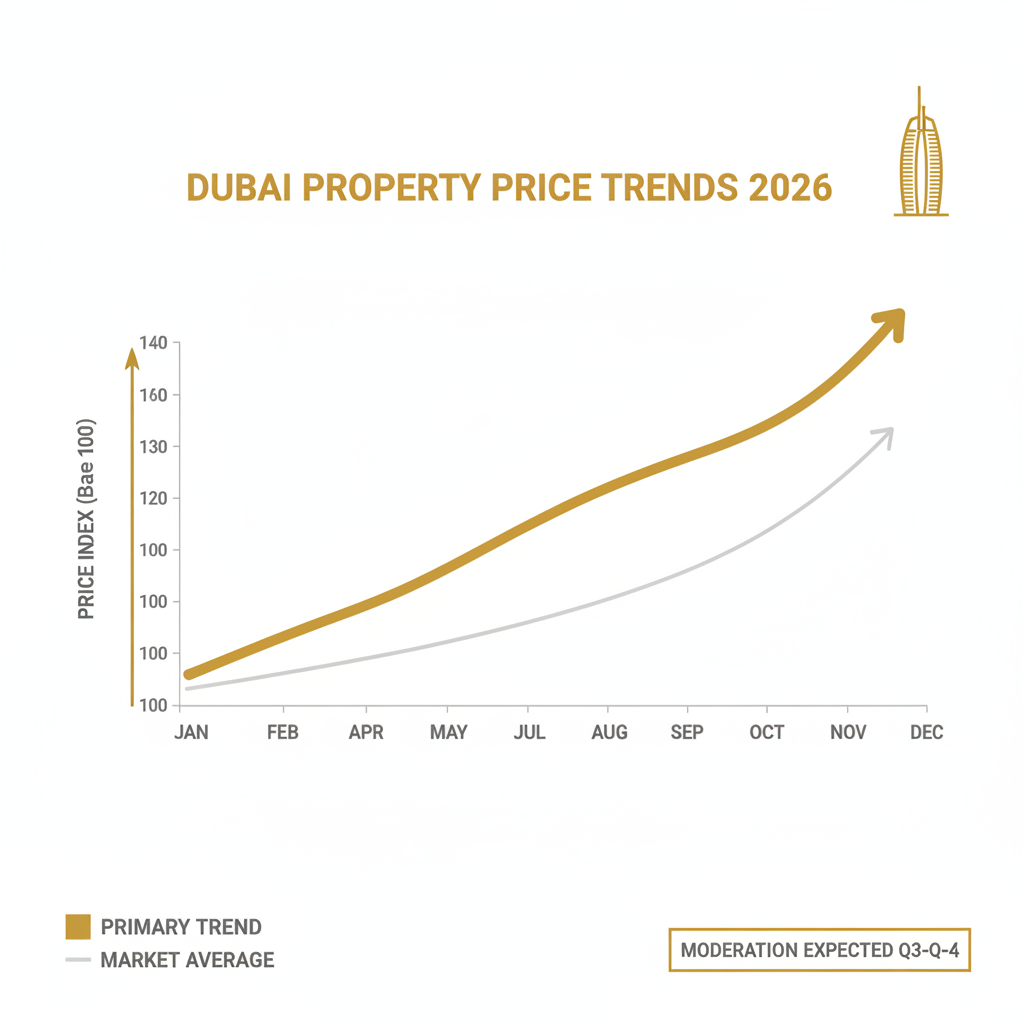 Investors entering Dubai real estate in 2026 must align their strategy with the market's maturation, balancing yield expectations, appreciation potential, and entry price sensitivity.
Yield versus appreciation strategies require clarity
Rental yield and capital appreciation do not always align in the same property or community. High-yield areas often feature affordable purchase prices and strong tenant demand from budget-conscious renters, but may experience limited price growth. Conversely, supply-constrained villa communities or prime waterfront locations appreciate steadily yet deliver lower rental yields due to higher entry costs.
Investors seeking monthly cash flow should target mid-market apartments in high-demand rental zones. Properties in JVC, Business Bay, Dubai Marina, and Al Furjan offer competitive yields and consistent tenant demand. Studios and one-bedroom units typically generate the highest yield percentages relative to purchase price.
Those prioritizing capital appreciation should focus on areas with infrastructure expansion, limited supply, and strong end-user demand. Dubai South, near the airport expansion zone, and emerging villa communities near new metro lines offer appreciation potential alongside moderate yields.
Trying to maximize both yield and appreciation often results in achieving neither. House Finder helps investors define their primary objective and select properties that align with their financial goals.
Timing entry prices matters more in a moderating market
Rapid price growth phases allow buyers to enter at almost any point and benefit from appreciation. Moderating markets reward precision. Understanding whether a community is approaching peak supply delivery or entering a post-handover stabilization phase directly affects negotiating leverage.
Off-plan properties accounted for roughly 70% of transaction volume in Q1 2026, driven by flexible payment plans and the appeal of below-market entry prices. However, off-plan appreciation depends heavily on developer reputation, delivery track record, and whether the community faces heavy competing supply upon handover.
Ready properties in the secondary market now represent a safer option for investors prioritizing immediate rental income and predictable ownership costs. Ready unit values jumped 48% year-on-year in early 2026, with transaction volumes increasing 8%, indicating sustained demand for move-in-ready assets.
Financing conditions improve but require disciplined analysis
Interest rates have begun to decline following US Federal Reserve cuts, easing borrowing costs for mortgage buyers. While cash buyers remain dominant at the top end of the market, lower rates are expected to support affordability and transaction activity in the mid-market.
Mortgage transactions rose 7.5% in Q1 2026, with total mortgage-backed deal value increasing 46% to AED 59.8 billion. Cash transactions still dominate the resale market at 67%, yet financed purchases are gaining share as rates improve.
Investors using leverage must calculate cash-on-cash returns rather than relying solely on gross yield figures. A 9% gross yield may translate to a 15% cash-on-cash return when mortgage financing is applied, assuming disciplined cost management and minimal vacancy.
Service charges in luxury towers can consume 30% of rental income, particularly in Downtown or DIFC buildings where fees exceed AED 25 to 30 per square foot annually. Always verify service charge indices and chiller fee structures before purchasing.
Portfolio diversification across asset classes and communities
Rather than concentrating capital in a single property or community, sophisticated investors diversify across asset classes and micro-markets. Combining a high-yield apartment in JVC with an appreciation-focused villa in Dubai Hills Estate balances cash flow with long-term wealth building.
Diversification also spreads supply risk. Communities facing heavy handover schedules may experience temporary rental yield compression, while neighborhoods with minimal new supply maintain stable or improving yields.
What trends mean for end users
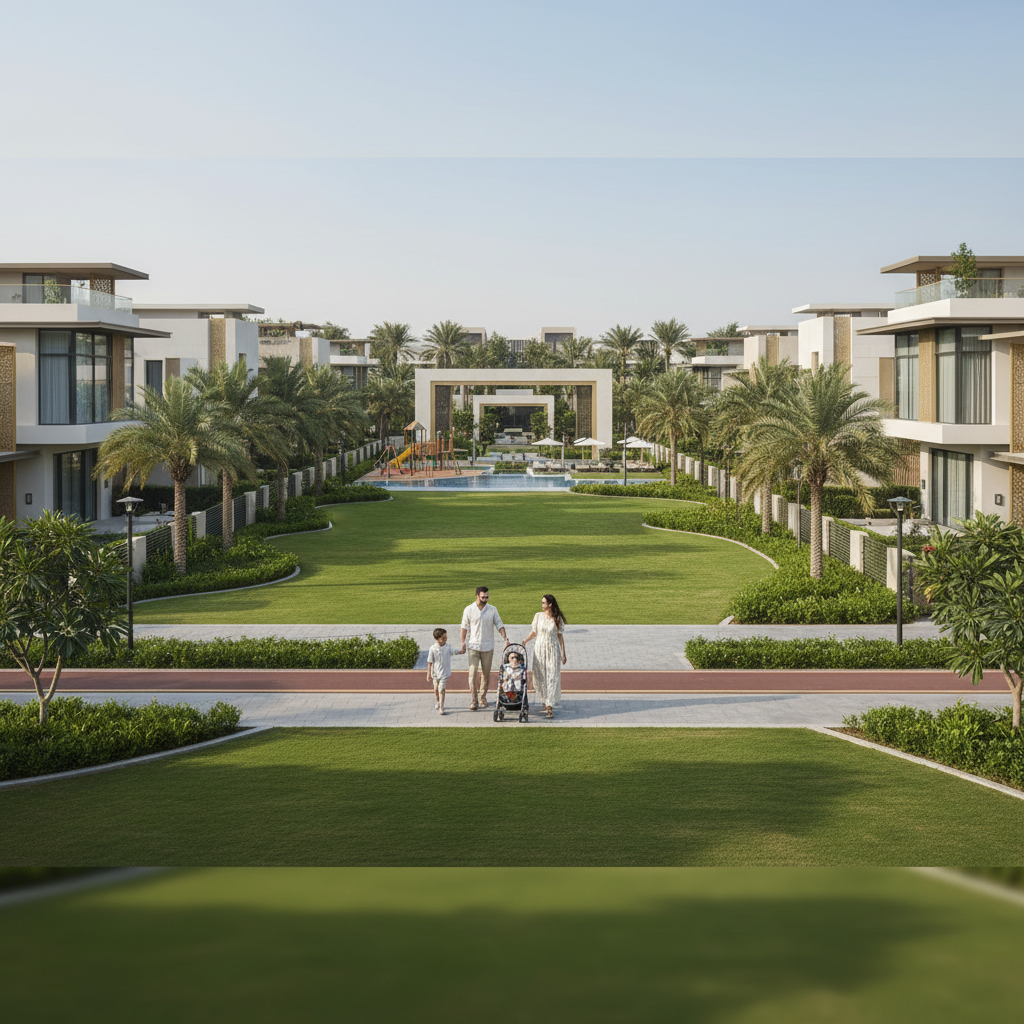 End-users buying homes to live in face a different decision framework than investors, with lifestyle fit, community stability, and long-term value outweighing short-term yield calculations.
Lifestyle and community infrastructure trump speculation
End-user demand in 2026 centers on established communities with mature infrastructure, schools, retail, and healthcare facilities. Families prioritize neighborhoods offering long-term stability and quality of life over early-stage projects with uncertain community development timelines.
Dubai Hills Estate, Arabian Ranches, The Springs, and Jumeirah Park consistently attract end-user buyers willing to pay premium prices for proven community appeal. These areas offer moderate yields and moderate appreciation alongside low turnover and strong neighborhood cohesion.
Proximity to schools drives significant demand, particularly from families with children. Communities near quality international schools command pricing premiums and experience faster resale velocity when owners eventually move.
House Finder understands that end-users need properties that fit their lives, not just their budgets. The platform's comprehensive property listings and expert consultation ensure buyers find homes in communities that match their family's needs.
Affordability shifts create opportunities in mid-market zones
While prime and ultra-prime segments remain expensive, mid-market zones offer improved affordability for first-time buyers and young families. Average apartment prices in communities like JVC, Arjan, Town Square, and Dubai South provide accessible entry points without sacrificing rental depth or resale liquidity.
Mortgage accessibility improvements, combined with moderating price growth, create a more favorable environment for end-users stretching to purchase. Government initiatives such as the First-Time Buyer Programme further support entry-level buyers navigating the market.
End-users should focus on total cost of ownership rather than purchase price alone. Service charges, maintenance fees, and community utility costs vary widely. Some buildings in Dubai Marina and JLT feature district cooling fees paid by landlords, adding AED 5,000 or more annually to operating costs.
Resale liquidity and long-term value retention
End-users may hold properties for five to ten years or longer, making resale liquidity and value retention critical considerations. Properties in high-liquidity communities with consistent transaction volumes sell faster and at more predictable prices than units in low-activity micro-markets.
Jumeirah Village Circle, Dubai Marina, Business Bay, and established villa communities consistently rank among the top areas by transaction volume, offering end-users confidence that future resale will not require extended marketing periods or deep price concessions.
Quality of construction, developer reputation, and building management standards affect long-term value retention. Properties from reputable developers with proven maintenance track records hold value better than poorly managed buildings requiring significant capital expenditure for repairs.
How to avoid overreacting to headlines
Media coverage of Dubai real estate often oscillates between euphoria and alarm, with headlines predicting either unstoppable growth or imminent crashes. Buyers who react emotionally to these narratives make poor decisions.
Focus on comparable data not citywide averages
Citywide average price movements hide vast differences between communities. A villa in Palm Jumeirah performs differently than an apartment in Dubai South. Broad market statistics provide context but should never replace granular community-level analysis.
House Finder provides property-specific data and community comparisons, ensuring buyers base decisions on relevant benchmarks rather than misleading averages.
Transaction volume fluctuations often reflect seasonal patterns or timing of developer launches rather than fundamental demand shifts. March 2026 saw transaction volumes drop to approximately 11,800 deals from 17,000 in February, prompting concerns about market weakness. Yet much of this decline reflected buyers and sellers pausing transactions or extending timelines rather than permanent demand erosion.
Distinguish between moderation, correction, and decline
Moderation means price growth slows but remains positive. Correction implies prices stabilize or dip modestly before resuming growth. Decline suggests sustained price falls over multiple quarters.
Dubai real estate in 2026 is experiencing moderation, not decline. Prices remain 13% higher year-on-year despite monthly fluctuations. This represents a market transitioning from acceleration to balance, absorbing previous gains while maintaining structural repricing above pre-pandemic levels.
Historically, Dubai's real estate cycles have been more pronounced than mature global cities, with sharper booms and busts. However, as the market matures, growth phases are becoming longer and volatility less extreme. The current cycle demonstrates demand-led stability rather than speculative excess.
Evaluate property fit not market timing
Attempting to time the market perfectly often leads to paralysis or poor decisions driven by fear of missing out or fear of buying at the peak. End-users buying homes to live in should prioritize property fit—does the home meet your family's needs, fit your budget, and sit in a community you want to live in for years?
If the answer is yes, short-term price fluctuations matter far less than long-term satisfaction and value retention. Waiting for the perfect entry point may mean missing suitable properties or facing higher prices as demand absorbs supply.
Investors should run detailed financial models incorporating realistic assumptions about rental yields, vacancy rates, service charges, and exit timelines. Properties that generate positive cash flow and meet target return thresholds justify purchase regardless of short-term headline noise.
Engage expert guidance and independent valuation
Navigating Dubai real estate in 2026 requires expertise that goes beyond online research. Independent property valuations, market analysis from credible sources, and guidance from experienced professionals help buyers avoid overpaying or purchasing in unsuitable communities.
House Finder offers expert consultation, comprehensive property listings, and end-to-end transaction management, ensuring buyers make informed decisions grounded in market reality rather than speculation or hype. Established in 2020, the platform bridges the gap between traditional brokerage and large-scale aggregators, delivering a solution-driven approach tailored to each client's unique needs.
Property trends matter, but property fit matters more. Understanding demand dynamics, pricing trajectories, and supply conditions provides essential context, yet the right decision always depends on your financial goals, lifestyle needs, and long-term plans. Dubai real estate in 2026 rewards informed, strategic buyers who stay grounded in comparable data and resist the urge to overreact to headlines.