Two apparently identical one-bedroom apartments in the same Dubai district can transact at price differences exceeding 150 percent. The gap is not an anomaly—it's a structural feature of how the market assigns value to comparable homes.
You'd expect two properties of similar size, configuration, and broad location to sit within a narrow price band. In most mature markets, they do. Dubai operates differently. Market data from early 2026 reveals that property valuation in Dubai reflects a layered system where unit-level comparisons often miss the attributes that truly drive price.
Understanding why seemingly comparable homes trade at vastly different levels matters for sellers, buyers, and investors who want to avoid mispricing and overpaying. This guide examines the specific factors that create pricing variation and explains how House Finder approaches these conversations with clients.
Why comparable homes can still sell for different prices
On the surface, a 700-square-foot one-bedroom unit should be directly comparable to another 700-square-foot one-bedroom. Configuration, layout type, and basic fit-out appear similar. Yet according to April 2026 transaction data, price per square foot within the same bedroom category varies by more than 150 percent between the lower and upper pricing bands.
This is not randomness. It's structure.
Project-level positioning creates the largest gap
In Dubai's residential market, the project carrying the unit matters more than the unit itself. Two apartments may share identical square footage, but if one sits in a recently launched development with branded amenities and waterfront positioning, while the other occupies a mid-2010s building in an interior plot, the pricing systems governing each unit are fundamentally different.
Buyers do not just purchase space—they purchase the project's reputation, the developer's track record, and the community's status. These attributes operate as premium layers that compound on top of the base unit price.
View, floor level, and orientation shift values substantially
Within the same building, units on higher floors with unobstructed views of landmarks such as the Burj Khalifa, Arabian Gulf, or Dubai Marina command premiums that can reach 20 to 35 percent above comparable lower-floor units. Professional valuers identify view premiums as quantifiable and consistently applied in DLD transaction data.
Floor level alone influences desirability and resale velocity. Units above the 15th floor in high-rise developments tend to attract faster interest, particularly from international buyers who associate elevation with exclusivity.
Orientation also matters. South-facing apartments receive more direct sunlight, which can be a drawback during peak summer months. North-facing and shaded units retain cooler indoor climates and are often valued higher in communities where climate control costs influence buyer preference.
Condition, fit-out quality, and upgrade history
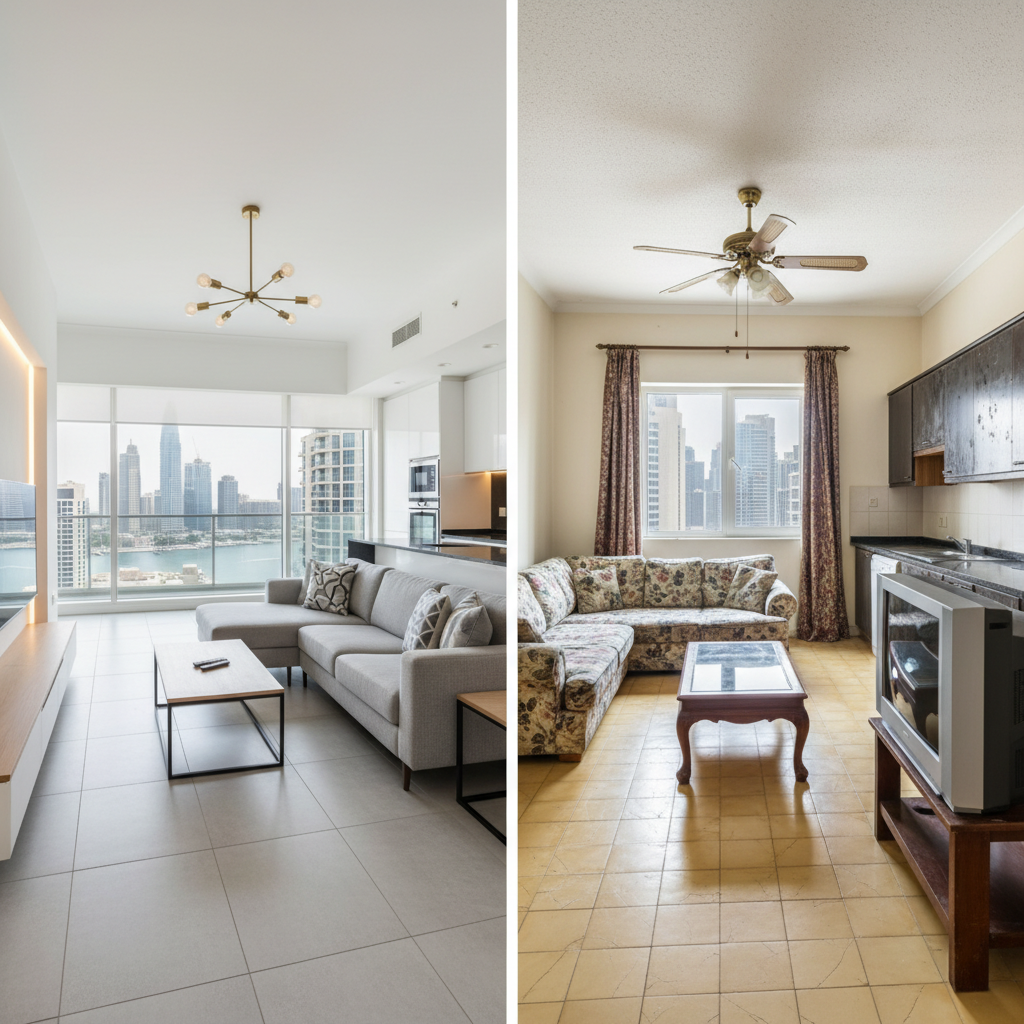
Two units in the same tower can present vastly different states of repair. A fully renovated apartment with European fixtures, upgraded flooring, built-in wardrobes, and modern kitchen appliances will trade at a material premium over an identical unit that has never been refurbished since handover.
Maintenance history also enters the equation. Properties that show signs of water damage, outdated AC systems, or poor upkeep face valuation penalties. Poor property maintenance and outdated fixtures are consistently cited as factors that negatively impact Dubai property valuation.
Buyers increasingly conduct pre-purchase snagging inspections and building audits. Units that fail these checks lose negotiating leverage, often resulting in price reductions of 5 to 10 percent.
Community strength and infrastructure maturity
Even within the same master development, individual communities can perform differently. Areas with operational schools, retail clusters, parks, and direct metro or tram access command premiums over sections still under construction or lacking essential infrastructure.
Communities with good schools, parks, and waterfront access see stronger price movement because families and long-term renters support stable demand. Investor appetite follows similar logic: neighbourhoods with strong rental occupancy and low tenant turnover attract capital looking for yield stability rather than speculative gains.
Areas such as Dubai Hills Estate, Arabian Ranches, and established zones in JVC benefit from this dynamic. Comparable homes in less mature pockets of the same district often trade at discounts approaching 15 percent.

How market timing affects valuation
Dubai's residential market does not move uniformly across time. Cyclical shifts, seasonal factors, and external sentiment all influence how much buyers are willing to pay at any given moment.
Price cycles create buying windows and seller advantages
The emirate has experienced pronounced price cycles over the past decade. Between 2020 and early 2025, residential values rose by approximately 80 percent in nominal terms. ValuStrat data shows that the Value Price Index fell 5.9 percent month-on-month in March 2026, although values remained 8.9 percent higher year-on-year.
These swings mean that two identical homes can sell at different absolute prices simply because one transacted during a demand peak in late 2025, while the other changed hands during the March 2026 correction.
Sellers who list during high-liquidity months—typically October through February—often achieve faster sales and stronger negotiating positions. Listings that hit the market during Ramadan, summer months, or periods of heightened geopolitical uncertainty face softer buyer appetite and longer time-on-market.
Off-plan versus ready property pricing divergence
Dubai's off-plan segment operates under different pricing mechanics than the secondary market. Off-plan units often carry premiums tied to developer brand, flexible payment plans, and completion timelines. Off-plan properties dominated 64 percent of transactions in January 2026, with an average 31 percent premium over ready homes.
However, off-plan carries execution risk. Buyers accept delayed handovers, construction quality uncertainty, and limited ability to inspect the finished product. Ready properties offer immediate occupancy, rental income activation, and verifiable condition—attributes that command their own premium among end-users and yield-focused investors.
Timing the purchase of an off-plan unit during early launch phases can result in capital appreciation before handover, particularly in high-demand projects. Conversely, buying near completion often means paying close to secondary-market prices without the benefit of rental yield during construction.
Interest rate shifts and financing cost volatility
Mortgage activity in Dubai has grown substantially. About 11,500 residential mortgage transactions were registered in Q3 2025, a 12.7 percent increase year-on-year. Rising interest rates compress affordability for leveraged buyers, reducing the pool of qualified purchasers and applying downward pressure on prices.
When financing becomes more expensive, cash buyers gain negotiating power. Properties that attract mortgage-dependent buyers may experience slower sales velocity and require pricing adjustments to remain competitive.
What sellers can improve before listing
Not all valuation factors are fixed. Sellers can influence how their property is perceived and priced by addressing specific attributes before engaging the market.
Presentation and staging create measurable uplift
First impressions drive buyer psychology. Homes presented with professional staging, neutral colour palettes, decluttered spaces, and high-quality photography consistently achieve higher offers than comparable units listed with poor visuals or occupied clutter.
Investing in deep cleaning, minor paint touch-ups, and fixture replacements can yield returns of two to five times the cost. Kitchens and bathrooms receive the most scrutiny—upgrading cabinet handles, replacing worn faucets, and re-grouting tiles are low-cost interventions with disproportionate impact.
Small fixes with leverage: maintenance and compliance
Addressing deferred maintenance before listing removes objections that buyers will use to negotiate down. Fixing AC units, repairing cracked tiles, ensuring all appliances function, and clearing any DEWA or service charge arrears demonstrates that the property has been responsibly managed.
Sellers should also ensure that all documentation is current and complete. Missing title deeds, unresolved NOC issues, or outstanding community fees create friction during the sales process and often result in last-minute price reductions to compensate for buyer inconvenience.
Timing the market and adjusting expectations
Pricing a property correctly from the outset is more effective than listing high and reducing later. Homes that sit on the market for extended periods develop a stigma, and buyers assume something is wrong. Data-driven pricing based on recent comparable sales within the same project and community—not aspirational figures—leads to faster transactions and stronger final prices.
Sellers should also be prepared to adjust pricing in response to market conditions. Price appreciation in Dubai is forecast to moderate to mid-single-digit levels of 5 to 8 percent in 2026. Listings priced for 2025 demand levels may require recalibration to reflect current buyer appetite.

How House Finder approaches pricing conversations
Accurate property valuation in Dubai requires more than automated algorithms and square-footage comparisons. It demands granular knowledge of project-level positioning, real-time transaction data, and an understanding of buyer behaviour across different market segments.
Data-driven methodology grounded in DLD transaction history
House Finder's valuation process begins with a detailed analysis of Dubai Land Department transaction records. We examine recent sales of comparable units within the same project, community, and broader district, filtering for recency, unit condition, and transaction type (cash versus mortgage).
We do not rely on listing prices, which often reflect seller aspirations rather than market reality. Our benchmarks are based on actual completed sales, adjusted for differences in floor level, view, fit-out quality, and timing.
Advisory role: aligning seller expectations with market readiness
Many sellers enter pricing conversations with valuations shaped by peak-market sentiment or anecdotal neighbour sales. Our role is to provide transparent, evidence-based guidance that balances seller objectives with current buyer appetite.
We present comparable sales data, highlight pricing trends within the specific micro-market, and explain how timing, presentation, and positioning will influence achievable pricing. This approach builds trust and ensures that listings enter the market at competitive levels that attract serious interest.
End-to-end transaction management and market intelligence
Property valuation is only one component of a successful sale. House Finder integrates pricing strategy with marketing execution, buyer qualification, negotiation support, and transaction coordination. Our team manages the full lifecycle—from initial valuation through DLD registration—ensuring that sellers achieve optimal outcomes without unnecessary delays or complications.
We also provide ongoing market intelligence, advising clients on when to list, when to hold, and how shifting conditions might affect their property's value. This proactive guidance is particularly valuable in a market as dynamic as Dubai, where timing decisions can materially impact final sale prices.

Frequently Asked Questions
What is the typical cost of a property valuation in Dubai?
DLD-certified property valuations start from AED 2,000 for vacant land and AED 4,000 for residential units, issued through authorised trustee centres.
Do two identical apartments in the same building ever sell for the same price?
Rarely. Floor level, view, condition, timing, and negotiation dynamics almost always create pricing differences, even for structurally identical units.
How much does view premium add to property value in Dubai?
View premiums for sea, Burj Khalifa, or golf course frontage typically range from 15 to 35 percent above comparable units without these views.
Should sellers renovate before listing?
Selective upgrades targeting kitchens, bathrooms, and cosmetic presentation typically yield positive ROI. Full renovations are rarely necessary unless the property shows material deferred maintenance.
How quickly do Dubai property valuations change?
Valuations can shift month-to-month in response to transaction velocity, new supply, interest rate changes, and broader economic sentiment. Regular updates are essential for accurate pricing.
House Finder is a comprehensive real estate service provider based in Dubai, offering property listings, mortgage assistance, and end-to-end transaction management. Established in 2020, the firm positions itself as a solution-driven platform bridging traditional brokerage and large-scale property aggregators. For expert consultation on property valuation and sales strategy, visit House Finder.