Dubai rental yields average 6.76% gross in 2026, but net returns drop to 4-5% after service charges, vacancy, and property management fees. The difference between headline figures and actual cash flow can make or break your investment strategy, especially when comparing apartments to villas or evaluating off-plan properties against ready stock.
Gross yield versus real return
The math most marketing materials skip
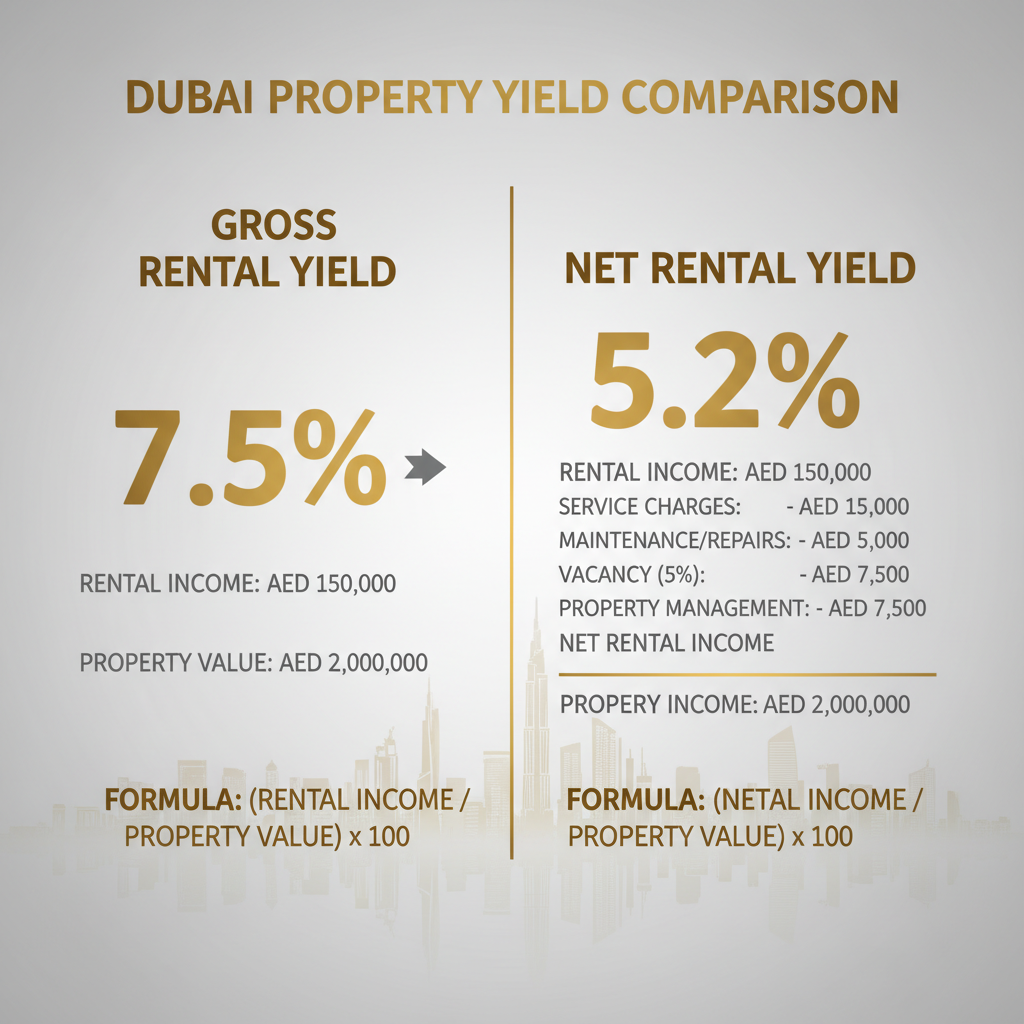
If you buy a one-bedroom apartment in Business Bay for AED 1,100,000 and rent it for AED 78,000 per year, your gross yield is 7.1%. But service charges at AED 15 per square foot on a 1,000 square foot unit cost AED 15,000 annually. That alone drops your net rent to AED 63,000, cutting net yield to 5.7%.
Most apartment investors in Dubai can realistically expect net yields between 4.7% and 6.7%, according to early 2026 data from industry sources tracking landlord profit and loss. The spread depends on how well you control costs and minimize vacancy.
Why service charges matter more than most think
Service charges in Dubai high-amenity buildings can eat up to 1.7% of property value annually. That makes them the single biggest drag from gross to net yield for apartment investors. According to 2026 benchmarks, average apartment service fees range from AED 10 to AED 30 per square foot, with premium towers in Downtown Dubai and Dubai Marina at the higher end.
High-end zones like DIFC and Dubai Marina cost more due to premium services. Older towers may need higher funds for repairs and system upgrades. Amenity count matters: pools, gyms, spas, and fountains all increase operational costs.
The vacancy factor investors underestimate
A conservative estimate for average residential vacancy in the UAE is around 6% in early 2026, translating to roughly 22 days empty per year. The realistic range spans from 3% to 5% in prime, high-demand communities up to 6% to 10% in investor-heavy buildings facing heavy new handovers.
Rising supply into 2026 means investors should budget an 8% vacancy buffer, roughly one month empty per year, rather than assuming continuous occupancy. Properties within walking distance of Dubai Metro stations typically rent 10% to 15% faster than similar units farther from transit.
Property management and hidden recurring costs
The typical property management fee for long-term rental apartments in Dubai is about 5% of annual rent in early 2026. That works out to roughly AED 4,500 to AED 5,500 per year for an average apartment. Standard fees include tenant sourcing, lease preparation, rent collection, coordination of routine maintenance, and acting as the tenant's point of contact.
Short-term rental management typically costs 15% to 25% of revenue due to higher workload. Full-service management with premium support can reach 8% of rent, while basic leasing-only services start around 4%.
What pushes yield up or down in Dubai
Purchase price and negotiation leverage
Negotiating the purchase price remains one of the most direct ways to improve yield. A better deal upfront improves your return over time. If two investors buy identical apartments but one negotiates AED 50,000 off the price, that investor immediately boosts yield by approximately 0.5% on a AED 1 million purchase.
House Finder works with buyers to assess fair market value and identify properties priced below market benchmarks. According to our transaction data, investors who engage early in off-plan cycles or target motivated sellers in ready stock often secure 5% to 8% discounts, materially improving long-term yield.
Rent levels and market timing
Year-over-year rent growth in Dubai has slowed to around 4% to 6% in early 2026, down from double-digit increases seen in 2023 and 2024. Renewed contracts tend to reflect lower rental growth compared to new leases due to rent increase controls and existing tenant protections. New contracts are priced at current market rates, which have risen steadily across most communities.
Peak rental demand in Dubai hits between August and October when families relocate before the school year starts. Well-priced apartments typically rent within 2 to 3 weeks during this window, and vacancy rates hover around 2% to 3% for properly maintained buildings.
Financing structure and leverage impact
If you finance 75% of a AED 1 million apartment at 5% interest, annual interest costs are AED 37,500. If net rent after all costs is AED 50,000, your cash-on-cash return on the AED 250,000 deposit is 5%, not the headline 6% net yield on total purchase price. Mortgage add-ons like arrangement fees and valuation costs also reduce effective returns.
Investors using leverage must calculate cash-on-cash return, not just cap rate, to understand true performance.
The community and building quality effect
Communities where prices are relatively reasonable, service charges are manageable, and tenant demand is constant tend to deliver the best rental yields. Affordable, mid-market areas like Jumeirah Village Circle, Dubai Silicon Oasis, and International City regularly push into the 7% to 9% gross yield range.
Prime locations such as Downtown Dubai and Dubai Marina sit closer to 5.8% to 6.5% gross, but they compensate with stronger long-term capital appreciation. The trade-off is usually slower capital growth, slightly more price sensitivity, and sometimes higher tenant churn in high-yield areas.
Which property types tend to perform better
Apartments lead on percentage yield
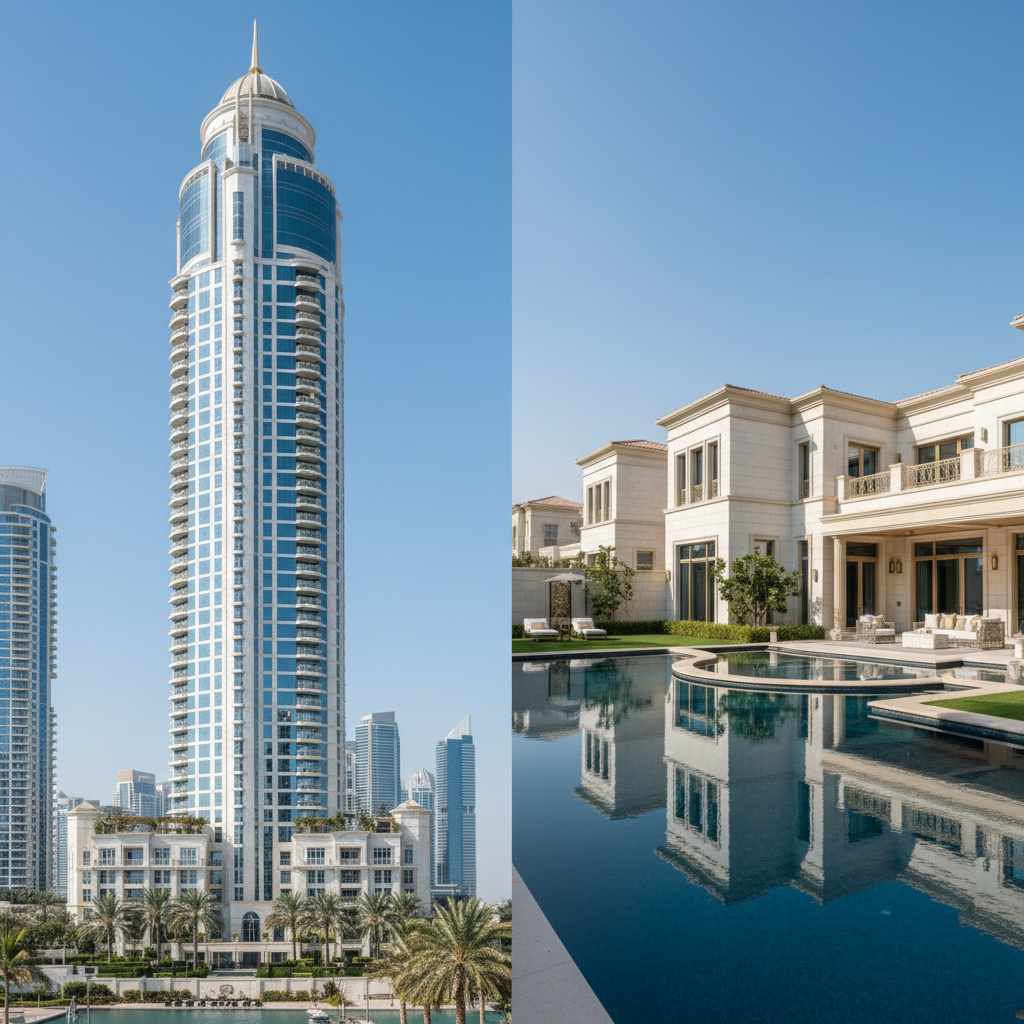
Apartments offered the highest rental yield in Dubai as of December 2025, with an average yield on rental property of 7.07%. Villas had a lower average rental yield of 4.93%. Studios and one-bedroom apartments in the UAE consistently outperform larger units on yield, often delivering 7% to 8.5% gross compared to 4.5% to 6% for villas.
The lower ticket size and deeper demand pool for compact units drive this outperformance. In most high-yield communities, studios and one-bedroom units outperform larger apartments on a percentage basis because the ticket size is lower and demand is deeper.
Villas attract different tenant pools
Villas appeal to larger families and often long-term residents on stable corporate packages. Villas generally attract long-term tenants who prefer stability and are willing to pay higher rents for privacy and space. However, vacancy cycles may be longer, and higher operational costs like gardens, pools, and larger plots reduce net yield.
While apartments averaged a 7% rental return in 2025, off-plan villas delivered a potent 14.7% in capital appreciation. Combined with rental yields, total returns pushed past 15.5%. For 2026, forecasts indicate solid yields in communities like Dubai Hills at 5.8% to 6.1% and Dubai South at 6.5%.
Off-plan opportunities and handover timing
Off-plan properties accounted for approximately 69% of total transactions in the first quarter of 2025. Newer projects often offer lower entry prices and higher rental returns once completed. Flexible payment plans across price points make off-plan apartments and villas accessible to a broader range of investors.
However, infrastructure delays can impact rental yields if the villa or apartment is ready but surrounding roads or amenities are not. Research the master developer's delivery track record before committing.
House Finder maintains a curated list of off-plan projects with strong ROI forecasts, focusing on developers with proven handover records and communities with established infrastructure timelines.
The best-performing communities in 2026
Jumeirah Village Circle posted average rental yields of 7.87% for studios in 2025, with the average sale price around $328,561, making it a relatively affordable entry point. Dubai Silicon Oasis registered 9.29% gross annually after Blue Line Metro news boosted demand. Sports City maintains yields between 8% and 9%.
Prime apartment areas like Business Bay, JLT, and Dubai Marina offer gross yields around 6.5% to 6.9%, with strong potential for short-term rental operations. Villa communities with good amenities and family-friendly environments like Al Furjan, DAMAC Hills 2, and Dubai Hills Estate offer robust yield, tenant stability, and long-term capital appreciation.
How to assess yield without getting misled

Verify service charges for the exact building
The RERA Service Charge Index, published annually, provides official benchmarks for every building in Dubai. It is publicly accessible through the DLD website and the Dubai REST app. Service charges significantly above the RERA index for similar buildings should raise red flags.
Service charges vary significantly by area, reflecting differences in building quality, amenities, and management standards. The developer and their appointed management company have a significant impact on service charge levels. Compare the service charges with similar properties within the same area to assess which fees are in line with market standards.
Calculate net yield using realistic cost assumptions
The practical approach is to verify service charges for the exact building, then calculate net yield after service charges, maintenance allowance, and realistic vacancy assumptions. Net yields in Dubai typically sit 1 to 2 percentage points lower than gross figures, depending on service charge structures and property management costs.
A well-priced apartment in Dubai typically finds a tenant within 2 to 4 weeks. During peak demand windows, usually September to November when new expats arrive for work, that can shrink to just 7 to 14 days. Budget for at least one month vacant per year unless you have strong evidence of lower vacancy in the specific building.
Cross-check rent assumptions with live market data
As of early 2026, the average monthly rent-to-price ratio in Dubai is approximately 0.52%. A property purchased for AED 1,000,000 would typically rent for around AED 5,200 per month. A monthly rent-to-price ratio above 0.55% is generally considered favorable for buy-to-let investors in Dubai.
Check multiple property portals and speak with agents actively leasing units in the same building or community. Avoid relying on a single data point or developer projections.
Understand the difference between new and renewed contracts
When evaluating rental yield potential in Dubai, distinguish between new contracts and renewals. Renewed contracts tend to reflect lower rental growth compared to new leases due to rent increase controls and existing tenant protections. Yields calculated using new contract data often appear stronger, offering a clearer benchmark for prospective investors.
New leases in 2025 are being signed at higher rents than many renewed Ejari contracts, which are partly constrained by the RERA rental index and uplift caps. Yield tables based on new contracts only will usually show stronger numbers.
Work with experts who show you the full picture
House Finder provides transparent yield analysis on every property, factoring in service charges, realistic vacancy rates, and current rental comparables. Our team walks investors through net yield calculations before they commit, ensuring no surprises after purchase.
We also connect buyers with mortgage advisors who model financing scenarios, property managers who quote realistic management fees, and legal consultants who explain RERA regulations. This end-to-end support helps investors make decisions based on actual cash flow, not marketing hype.
How House Finder helps investors find genuine high-yield opportunities
House Finder specializes in connecting buyers with properties that deliver strong net returns, not just attractive gross yield headlines. Established in 2020, the platform bridges the gap between traditional brokerage and large-scale property aggregators by offering personalized consultation, transparent cost breakdowns, and access to both on-market and off-market listings.
Our advisors help investors assess fair market value, negotiate better purchase prices, and identify communities with manageable service charges and low vacancy risk. We also provide detailed yield projections that include all recurring costs, ensuring you understand real cash flow before signing.
Whether you are evaluating apartments in Jumeirah Village Circle, villas in Dubai Hills Estate, or off-plan projects in Dubai South, House Finder delivers the data and support you need to invest with confidence.
Frequently Asked Questions
What is a good rental yield in Dubai in 2026? Local investors generally consider a gross rental yield of 6.5% or higher to be good, with anything above 7.5% looking very attractive.
How much do service charges reduce rental yield? Service charges typically reduce gross yield by 1 to 2 percentage points, depending on building amenities and management efficiency.
Do apartments or villas offer better rental yield? Apartments typically offer higher percentage yields, averaging 7.07% gross, while villas average 4.93% but often deliver stronger capital appreciation.
How long does it take to rent out a property in Dubai? Well-priced apartments typically rent within 2 to 3 weeks, with peak demand between August and October during school relocation season.
Are off-plan properties better for rental yield than ready stock? Off-plan properties often offer lower entry prices and higher potential yields once completed, but carry handover and infrastructure timing risks.