RERA compliance in Dubai signals regulatory approval, but it's not a guarantee of service quality, market expertise, or transaction success. It confirms baseline legal standing—nothing more, nothing less. Buyers and sellers still need to verify project registrations, escrow protocols, and broker track records independently.
When you search for property in Dubai, nearly every agency website displays a RERA badge somewhere in the footer.
The Real Estate Regulatory Agency under the Dubai Land Department oversees broker licensing, developer registration, and escrow account management. In 2026, over 39,700 licensed brokers operate across more than 7,900 registered firms, each holding valid credentials issued by the regulatory authority. But having RERA credentials is legally mandatory, not a competitive differentiator.
The challenge begins when buyers assume compliance equals competence. It doesn't. The badge confirms that a broker passed a basic exam, completed training through the Dubai Real Estate Institute, and renewed their certification annually. It does not vouch for market knowledge, negotiation skill, ethical judgment, or client service quality. House Finder approaches RERA compliance as a starting point for trust, not the finish line.
What RERA compliance is supposed to signal
RERA compliance exists to create a regulated framework that protects both transaction parties and market integrity.
Every licensed broker must hold a valid RERA ID card, complete continuing professional development courses, and operate under a registered brokerage. The regulatory system enforces mandatory disclosure standards, proper advertising permits through the Trakheesi platform, and adherence to the three-broker listing rule, which limits the number of agents simultaneously marketing a single property.
Legal authority to transact
Without RERA licensing, an individual cannot legally represent buyers or sellers in property transactions within Dubai. The certification grants legal standing to negotiate terms, prepare contracts, and facilitate closings. According to recent compliance reports, approximately 85% of licensed brokers complete annual CPD requirements, maintaining current knowledge on regulatory changes and market shifts.
This baseline ensures that brokers understand tenancy law, freehold versus leasehold distinctions, and Ejari registration procedures. It does not ensure they understand micro-market dynamics, developer reputations, or construction quality indicators.
Escrow account protections
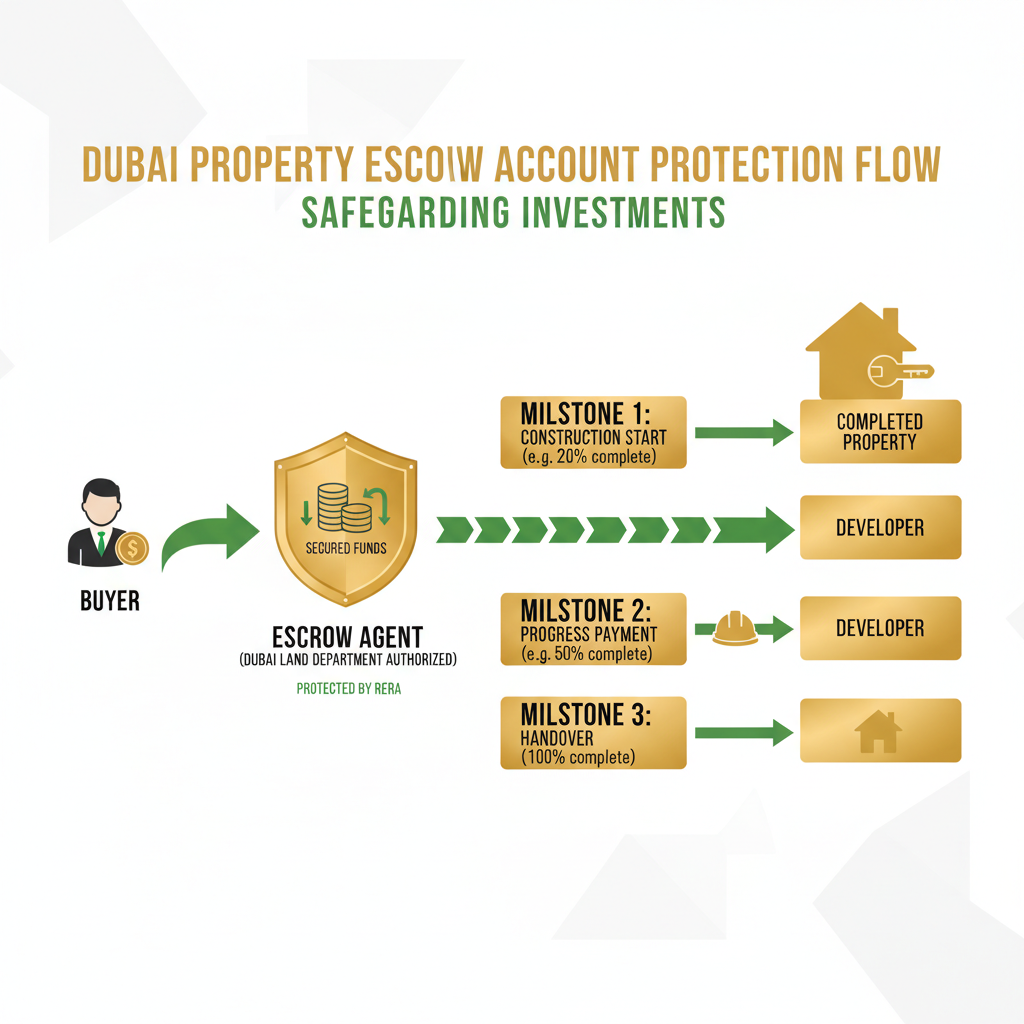
For off-plan purchases, RERA mandates that developers open separate escrow accounts for each project, managed by accredited escrow agents approved by the Dubai Land Department.
Buyer instalments flow into these ring-fenced accounts and can only be released when verified construction milestones are met. Law No. 8 of 2007requires that 5% of total project value remains locked in escrow for one year after handover, creating a post-completion quality buffer.
Creditors of the developer cannot attach funds in project-specific escrow accounts for unrelated debts, a critical protection if a developer faces financial stress elsewhere. These mechanisms reduce fund misuse risk but do not eliminate delays, construction defects, or resale liquidity challenges.
Advertising and listing standards
Every property advertisement in Dubai must display a valid Trakheesi permit number issued by the Dubai Land Department.
Portals like Property Finder and Bayut automatically scrub listings that lack proper permits. Brokers advertising properties without signed seller authorization or using fake permit numbers face fines up to AED 50,000 per violation and potential license suspension. This enforcement reduces ghost listings and misleading inventory claims.
House Finder ensures all marketing materials carry current permits and that each listing reflects verified availability, pricing, and property condition.
Why it matters for buyers and sellers
RERA compliance creates a safer transactional environment, but it does not replace buyer due diligence or seller scrutiny.
Trust in the transactional framework
Knowing that brokers operate under regulatory oversight provides foundational confidence.
Buyers can verify broker credentials through the Dubai Brokers Registry, checking license status, affiliated brokerage, and any recorded violations. This transparency allows clients to filter out unlicensed operators who lack accountability and legal recourse channels.
For sellers, working with RERA-licensed brokers means contract templates meet legal standards, commission structures follow published guidelines (typically 2% on sales, 5% on annual rent for leases), and marketing practices comply with advertising regulations.
Dispute resolution mechanisms
RERA established the Rental Disputes Centre to handle landlord-tenant conflicts and broader property disagreements.
Compliance with RERA standards makes it easier to file complaints, pursue remedies, and enforce contracts through official channels. In 2020, the Dubai International Financial Centre Courts saw a 41% increase in real estate dispute filings, reflecting growing transaction volume and the need for structured resolution pathways.
Brokers who maintain clean compliance records demonstrate operational discipline. Those with repeated violations or suspensions signal red flags that buyers should not ignore.
Market data transparency
RERA maintains the Smart Rental Index, a data-driven benchmark that determines permissible rent bands for tenancy renewals.
Landlords cannot impose rent increases outside index-approved ranges, and tenants can challenge unjustified hikes using the RERA Rent Calculator. This indexed approach reduces arbitrary pricing and promotes long-term market stability.
For buyers evaluating investment yield, access to regulated rental data improves forecasting accuracy and supports informed acquisition decisions.
Where buyers still need to do their own checks
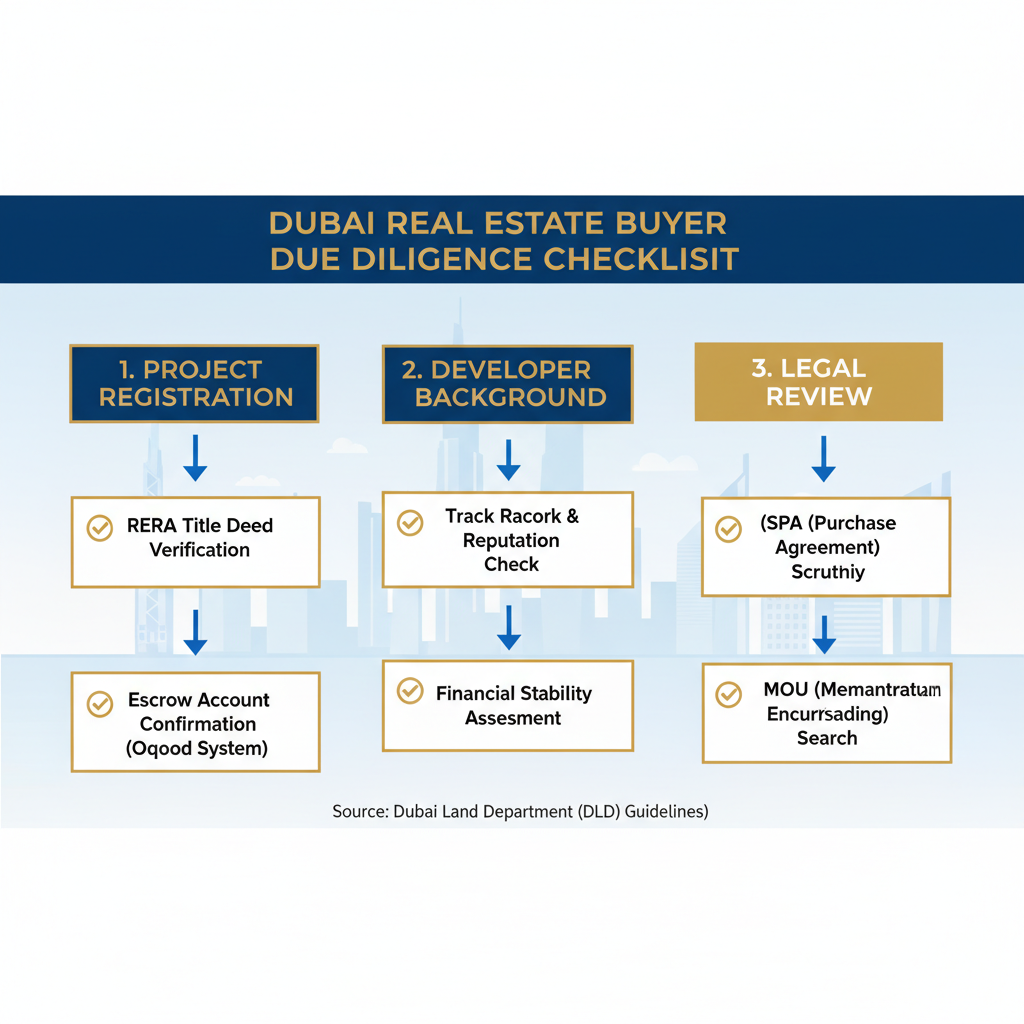
Compliance is necessary but not sufficient. Buyers must verify project legitimacy, developer track records, and property condition independently.
Project registration and construction progress
Not every development marketed as "RERA approved" has completed full registration or met all pre-launch requirements.
The Dubai Land Department requires developers to submit final building permits, a 30% construction guarantee (via completion milestone, bank guarantee, or cash deposit), and an investor compensation mechanism before launching off-plan sales. Buyers should confirm that the project appears in the official DLD Register Project database, not just in broker marketing materials.
Construction timelines slip. Delays happen. Regulatory approval does not guarantee on-time handover or prevent quality issues. Buyers should request independent engineering reports, visit construction sites, and review developer histories before committing funds.
Developer financial health and reputation
RERA licensing applies to brokers and developers, but it does not assess developer solvency or project viability in real time.
A developer can hold a valid license while facing cash flow challenges, project overruns, or legal disputes on other developments. Buyers should research the developer's portfolio, completion rates, and any reported delays or buyer complaints. Industry data shows that 67% of foreign property buyers were dissatisfied with initial agent selections, leading to average financial implications of $45,000 in opportunity costs or direct losses.
House Finder conducts internal due diligence on developer partners, tracking handover performance, post-sale support quality, and community management standards before recommending projects to clients.
Escrow account verification
Buyers should confirm that the escrow account exists, is project-specific, and is managed by a DLD-accredited escrow agent.
Request account details in writing. Verify that payments flow into the designated escrow account, not into a developer's general operating account. The Real Estate Escrow Account Division of RERA audits and monitors escrow accounts regularly, but buyers retain primary responsibility for verifying fund protection mechanisms.
If a developer resists providing escrow documentation or offers alternative payment structures, walk away.
Legal and title deed verification
RERA compliance does not replace conveyancing due diligence.
Buyers should engage qualified real estate lawyers to review contracts, verify title deed authenticity, confirm that the seller holds clear ownership, and check for encumbrances or liens. Legal professionals recommend this step for all transactions, particularly when acquiring resale properties or dealing with individual sellers.
House Finder collaborates with vetted conveyancing partners to streamline legal review, title transfer, and registration processes, ensuring buyers receive accurate documentation at every stage.
Broker track record and service quality
A RERA license does not measure broker expertise, responsiveness, or ethical conduct beyond minimum standards.
Buyers should request client references, review online testimonials, and assess whether a broker demonstrates deep knowledge of target communities, property types, and market conditions. Ask specific questions about recent transactions, average time to close, and how the broker handles post-sale issues.
If a broker cannot provide clear answers or relies solely on the RERA badge to establish credibility, consider alternative representation.
How House Finder approaches trust and transparency
House Finder treats RERA compliance as the foundation, not the ceiling, of client service.
Verified listings and current market data
Every property listed through House Finder undergoes verification to confirm availability, pricing accuracy, and condition.
Internal systems cross-reference Trakheesi permit numbers, seller authorizations, and property ownership records before publication. This reduces wasted time on ghost listings and ensures clients view only legitimate, currently available inventory.
Market data updates reflect real-time transaction activity, rental trends, and supply-demand shifts across Dubai micro-markets, supporting informed decision-making.
Developer partnerships and project vetting
House Finder maintains relationships with established developers who demonstrate consistent handover performance, transparent escrow management, and post-sale support.
Before recommending any off-plan project, internal teams review construction progress, financial stability indicators, and historical buyer satisfaction. This vetting process filters out higher-risk developments and focuses client attention on projects with strong completion track records.
Clients receive detailed project briefs that include construction timelines, payment schedules, amenity delivery dates, and community management plans.
End-to-end transaction management
Beyond property search and negotiation, House Finder coordinates mortgage assistance, legal review, title transfer, and post-purchase support.
Clients work with a single point of contact who manages all transaction elements, reducing coordination friction and ensuring nothing falls through procedural cracks. This integrated approach reflects the firm's positioning as a comprehensive real estate service provider, not just a listing aggregator.
Transparency extends to fee structures, timeline expectations, and potential risks associated with specific properties or market segments.
Ongoing client education
House Finder provides clients with plain-language explanations of RERA regulations, Dubai property laws, and common transaction pitfalls.
Educational content covers topics like Ejari registration, freehold versus leasehold distinctions, rent increase caps, and off-plan buyer protections. Clients gain the knowledge needed to ask informed questions, spot red flags, and understand their rights and obligations throughout the buying or selling process.
This educational commitment builds long-term trust and positions clients to make confident, well-informed decisions in a complex regulatory environment.
Frequently Asked Questions
What does RERA compliance actually mean for a Dubai broker? It means the broker holds a valid license issued by the Real Estate Regulatory Agency, has completed required training, and can legally represent clients in property transactions.
Can I verify a broker's RERA license online? Yes, the Dubai Land Department maintains a public registry where you can confirm broker credentials, license status, and affiliated brokerage by searching the RERA ID number.
Does RERA compliance protect me from broker fraud? It provides legal recourse channels and accountability but does not eliminate fraud risk. Buyers must still verify contract terms, property ownership, and fund transfers independently.
Are all Dubai property developers RERA registered? Legally, yes. Developers must register projects with the Dubai Land Department and comply with escrow account regulations before launching off-plan sales, but buyers should verify registration independently.
How often do RERA brokers need to renew their licenses? RERA certificates last one year. Brokers must complete continuing professional development courses and pass renewal exams annually to maintain their licenses and stay current on regulatory changes.